
Quarterly Round-Up
Blog
October 19, 2026
10 mins
Welcome to our Q3 2026 M&A Insights newsletter. This edition brings together two perspectives: the latest market reports (MarktoMarket, Dealsuite, BCG, Reuters/LSEG, EY, White & Case and others) and our own analysis of 151 UK transactions valued at up to £100m that completed or were announced between July and September 2026.
Both tell the same story. The UK is heading for a record year by deal value, driven by overseas buyers and a small number of larger deals. Underneath, the market is selective: most transactions are small, buyers pay a premium only for specialist or scalable businesses, and the macro backdrop has become more demanding ahead of the 28 October Budget.
This edition also draws on more than a dozen conversations we had between July and September with clients, corporate finance advisers, PE and debt investors, and acquirers. Their day-to-day experience backs up what the data shows, and we've added it alongside the numbers below.
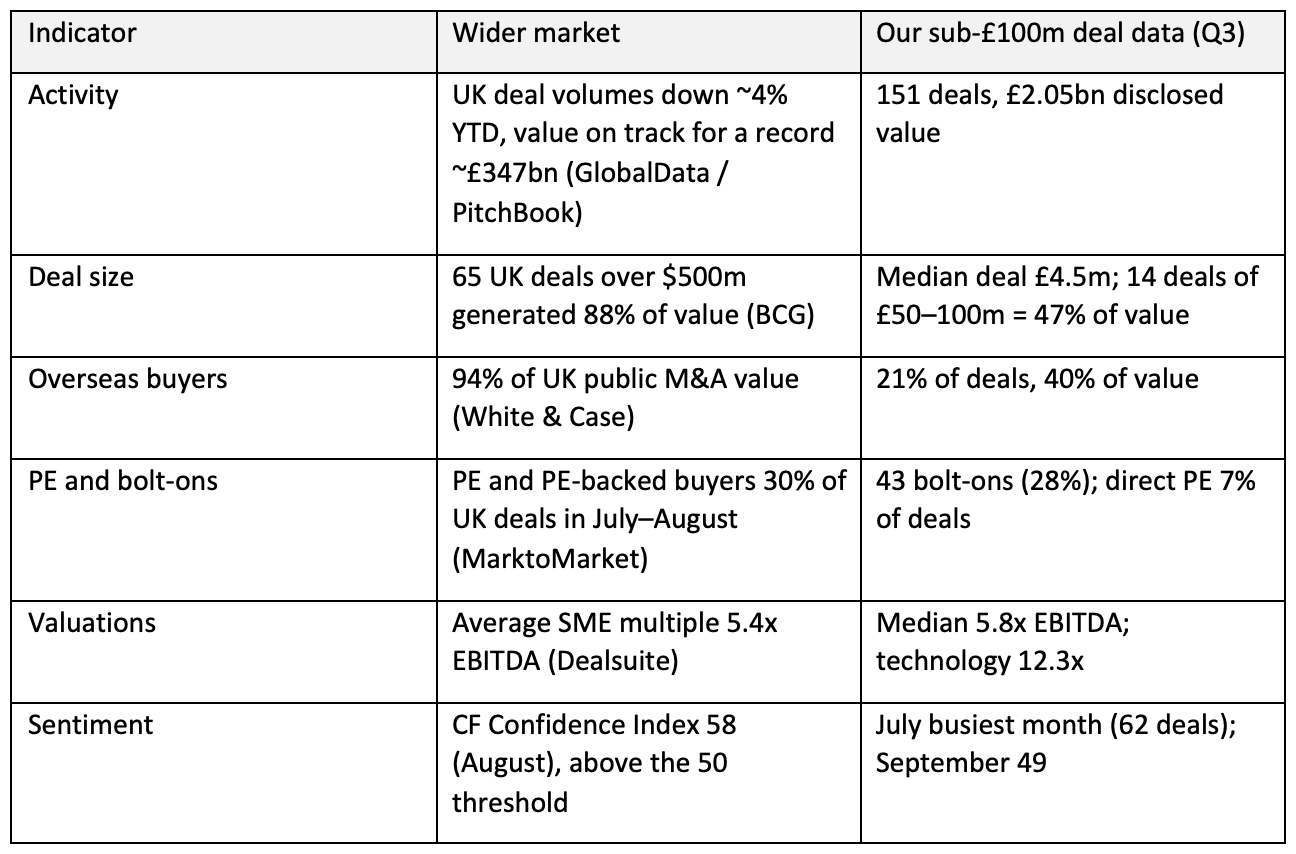
Market view: Globally, Q3 deal value fell 41% from an exceptional Q2, though it is still up 28% year to date. Deal numbers are at their lowest since 2020 (Reuters/LSEG). In the UK, BCG reports value almost doubling in the first seven months, while deal numbers fell from 2,272 to 1,763. The North West shows the same pattern locally: deal numbers fell 21%, while value rose 23%.
Our Q3 data: Most deals are small. Half of disclosed transactions were under £5m, and the median was £4.5m. Value is concentrated at the top end: the 14 deals between £50m and £100m account for almost half of disclosed value. Activity peaked in July (62 deals), dipped in August (40) and recovered in September (49).
From our conversations: A September UK market review put deal volume on track for 6,000+ transactions this year, with more than 80% below £50m. Most SMEs valued at up to around £20m are trading at 4–6x EBITDA. The best still command 10x+, but the bar to get there is much higher, and average multiples are around 2 turns lower than 5 years ago. "Promise to proof": buyers won't pay for forecasts and want evidenced historic numbers. Pricing appetite has softened, and the bar to enter a sale process is far higher than it was.
Takeaway: There is no shortage of buyers or capital. However, the larger, competitive outcomes are reserved for a minority of well-positioned businesses.
Market view: UK public M&A value through Q3 is almost double the whole of 2025. Overseas bidders account for 94% of that value, and hostile and "bear hug" approaches are rising. BCG notes that inbound acquisitions of UK assets have returned to 2021–22 levels, and a strong dollar is encouraging US buyers.
Our Q3 data: The same dynamic reaches the lower mid-market. Overseas buyers made 32 of 151 deals (21%) but accounted for 40% of disclosed value. Their median deal of £16–24m compares with £2.9m for UK buyers. The US was the largest single source (9 deals, £252m). Inbound interest is concentrated in technology (37% of deals) and industrials (57%). Examples include Karman (US) buying Walker Precision for £70m, Vossloh (Germany) taking Cordel private and Esyasoft (UAE) taking CyanConnode private.
From our conversations: The same market review found UK buyers still outnumber overseas buyers by around 4 to 1, which matches the 21% overseas share in our data. But US acquirers are paying 10–14x EBITDA against 6–8x for UK buyers. Strategic acquisitions rarely happen cold. The buyer almost always knows the business well before the deal.
Takeaway: Specialist UK businesses, particularly in technology, defence and precision engineering, should reach international buyers when running a sale process.
Market view: PE-backed bolt-ons rose to 20–21% of UK deals over the summer, the highest share this year (MarktoMarket). Dealsuite reports buyer interest per sale process rising to 8.5 parties. Business services is expected to be the strongest growth sector for the third edition running.
Our Q3 data: Consolidation and bolt-ons were the most common rationale for operating businesses (43 deals, 28%), but these deals are small, with a median of £2.6m. Serial acquirers included Knights (three law firms, £32.7m), Croma (security), Analytical Expert Labs (testing) and Punch (pubs). Direct PE accounted for only 10 deals (7%), but they were larger (median £12.6m) and often growth or minority investments such as Strathberry, Conquip and Revive!.
From our conversations: What sets a seller apart is being clear about what they want from a buyer. We saw the same move away from direct PE deals toward buy-and-build platforms, and warned that rollover gets more complicated in these structures, starting with which level of the group your equity rolls into. Several clients have received unsolicited approaches this year from family offices.
Takeaway: Professional services, security, testing, legal, accountancy and estate agency businesses face an active pool of acquirers. Most of these acquirers are building platforms rather than paying for standalone value.
Market view: The average UK SME multiple held at 5.4x EBITDA, with a steep size premium: 3.6x at £200k EBITDA rising to 8.2x at £10m (Dealsuite). BCG describes AI as a "double-edged sword": it creates opportunities but makes some business models harder to value. Generic software is now expected to see fewer deals, while mission-critical industrial software traded at an average of 4.5x revenue (MP Corporate Finance).
Our Q3 data: The median operating-company multiple was 5.8x EBITDA (0.9x revenue), closely in line with the market. Pricing is polarised by sector:
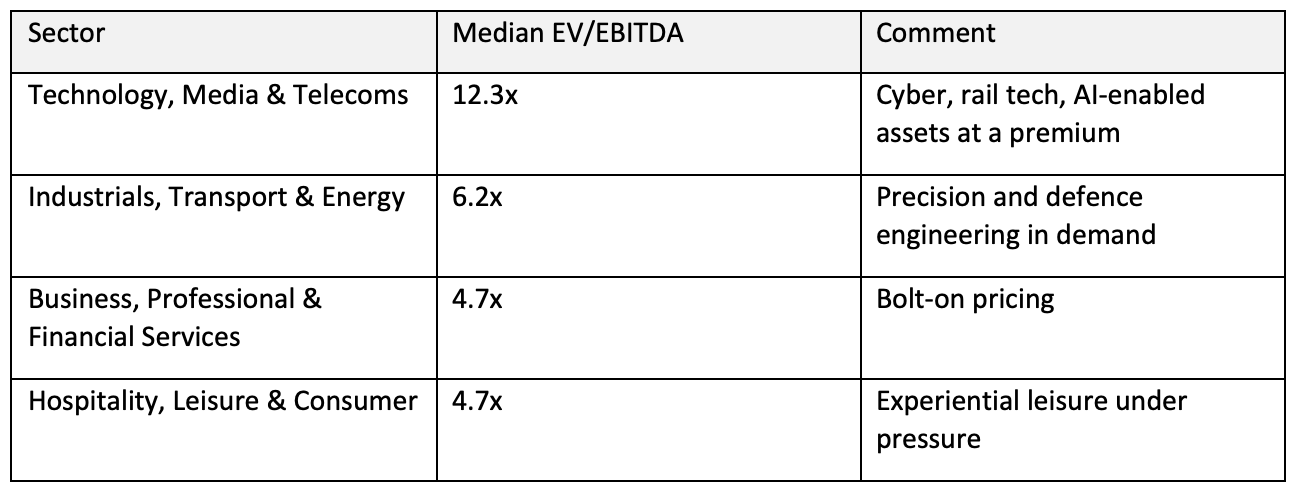
The highest prices went to capability: Plus Group (AI-driven adviser support) at 53.5x EBITDA, Mistral Data (rail software) at 14.0x and Ideal Networks (managed IT and cyber) at 12.3x. At the other end, Boom Battle Bar (1.5x EBITDA), Mobico's bus operations (1.6x) and Harvey Nichols (0.2x revenue) show how harshly weaker trading is being priced.
From our conversations: Investors and advisers described the same split. One adviser cited a 4x to 13x multiple range within a single industry.
The question of whether a business is AI-defensible or AI-vulnerable is now standard at PE investment committees. PE houses are avoiding whole sectors, professional services among them, and tech businesses with easily copied propositions are struggling to sell. Hot sectors are compliance and regulatory services, healthcare, infrastructure, and defence and aerospace.
Takeaway: Buyers pay for scale, recurring revenue and hard-to-replicate capability. A credible AI narrative now affects value directly, positively or negatively.
Market view: BCG sees portfolio rotation as the key to broadening the recovery. In its view, too few transaction-ready assets are coming to market. PE holds over 33,500 unsold portfolio companies, and a third of European PE assets have been held for more than seven years.
Our Q3 data: Corporates are actively reshaping portfolios:
From our conversations: PE hold periods at around 7 years, against 5–6 years between 2010 and 2021.
Takeaway: Corporate disposals are a growing source of opportunities for acquisitive owner-managers and financial buyers alike.
Market view: The 10-year US Treasury yield hit 5.34%, and UK gilt yields are at their highest this century. EY estimates fiscal headroom has halved to £11.3bn, with capital gains and wealth-related taxes among the few levers left for the 28 October Budget. UK corporate lending growth is forecast to more than halve, to 2.1% in 2026. Altius reports owners accelerating sales to lock in current reliefs.
From our conversations: Most owner-managers have no succession plan and are worried about tax changes, with around 75% of directors aged 41+ and considering a transaction.
Deal structuring: As valuation gaps persist, earnouts are now standard. However, SRS Acquiom data shows sellers ultimately receive only around 21% of potential earnout value. In half of UK sale processes, seller expectations are too high, typically by around 23% (Dealsuite).
From our conversations: Earnouts are coming back, with gross margin targets now preferred to revenue or EBITDA because they're cleaner and harder to manipulate. Where consideration is rolled into a buyer's shares, one adviser recommended insisting on a defined exit or price crystallisation at 5 to 10 years.
Takeaway: Financing is more selective and tax uncertainty is high. Sellers should focus on the certainty of upfront value and plan exit timing with tax advice.
Q3 2026 confirms a UK market that is active, well-funded and increasingly selective. Overseas buyers, consolidators and corporate portfolio moves are driving the deals, while valuation discipline, higher borrowing costs and Budget uncertainty are keeping buyers focused on quality. For well-prepared owner-managed businesses, especially those with specialist capability, conditions remain favourable.
Across our conversations this quarter, the people making and financing deals said the same thing in different ways: buyers want proof, and they reward businesses that can show it.
As always, please get in touch if you would like to discuss how these trends might affect your business or plans. Whether you are considering an exit, seeking growth capital or planning for succession, we are here to help.
Interested in our events?

Implicit Advisory Limited is a Private Limited Company registered in England and Wales under registered number 13405906 whose registered office address is at Hyde Park House, Co AJ Fleet & County Limited, Hyde, SK14 4EH.


