
UK Deal Market Intelligence
Blog
May 5, 2026
3 mins
The UK M&A market has entered 2026 with more momentum and more optimism than it has shown since 2021. After a period of caution driven by the 2024 Autumn Budget's NIC and CGT changes, market conditions have improved meaningfully. Buyers are active. Capital is available. And confidence among corporate finance advisors has reached its highest recorded level in over a year.

These headline numbers tell a story of a market that is active at both ends of the scale - from the £15.8bn Engie/UK Power Networks deal to hundreds of smaller SME transactions completing each month. For business owners, the key message is this: if your business is well-positioned and well-prepared, there has rarely been a better time to test the market.
UK M&A volumes in the early months of 2026 are tracking ahead of the same period in 2025. MarktoMarket's Valuation Barometer recorded 399 deals in January 2026 (estimated final: 474, representing over 20% year-on-year growth) and 373 in February 2026 (estimated final: 443). Across Europe, deal flow is also strengthening, with the majority of regions reporting more transactions in H2 2025 than in H1 2025.
But volumes are only part of the story. The more important trend is the shift in buyer behaviour: buyers are being more selective, concentrating their activity on businesses that meet a higher quality threshold. PwC data shows UK total deal volumes fell 12% year-on-year in 2025, but total deal values rose 12% to £131bn, and average deal size grew by 28%. Fewer deals are completing - but those that do are attracting stronger pricing from better-prepared sellers.
Volume is not the risk. Selectivity is. Buyers are active and well-capitalised, but they are not chasing every deal. Businesses that are organised, transparent, and strategically coherent will attract serious buyers quickly. Those that are not will struggle to convert interest into completed transactions, regardless of how buoyant the market is overall.
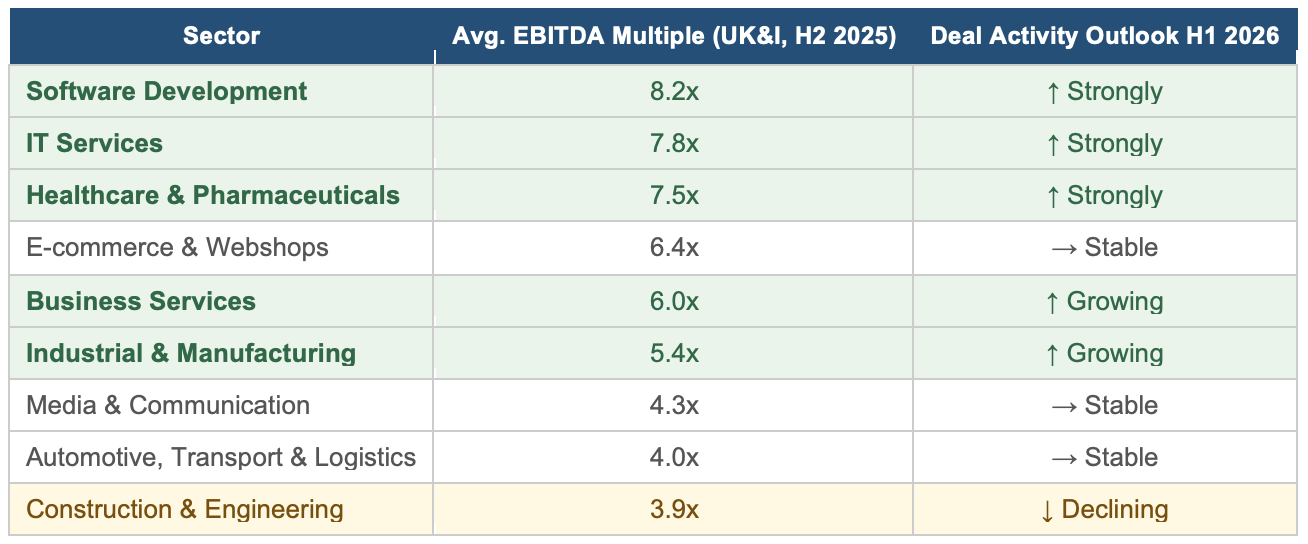
The single most important data point for any business owner considering a sale is the EBITDA multiple - the number by which your normalised annual profit is multiplied to reach an enterprise value. In the UK mid-market, this multiple averaged 5.4x in H2 2025 (Dealsuite UK&I Monitor), and it varies significantly by sector and company size.
The Size Premium: Why Scale Matters
One of the most significant but least understood factors in business valuation is the 'Small Firm Premium', the discount applied to smaller businesses to reflect their higher perceived risk. Dealsuite's UK&I data makes this starkly clear:

This means a business growing its normalised EBITDA from £500k to £1m is not just doubling its earnings, it may be increasing the multiple applied to those earnings from approximately 4.3x to 4.9x. The combined effect is a step-change in enterprise value that is far greater than the earnings increase alone. This is one of the most powerful levers available to any business owner preparing for sale: grow earnings, and the multiple applied to those earnings grows with you.
If your business currently generates £500k-£1m of normalised EBITDA, even modest improvements in earnings, through better margin management, overhead reduction, or revenue growth, can have a disproportionate impact on your final sale price. The value is in the jump between size brackets, not just the number itself.
Understanding who is likely to acquire your business is as important as understanding your valuation. Different buyers have different motivations, different timelines, and different impacts on the price they are willing to pay. In the current market, three buyer types dominate.

If your business has a strong market position, proprietary technology, a loyal customer base, or a geographic presence that a competitor would value, a trade sale is likely to generate the strongest outcome.
PE interest in UK businesses has increased significantly, driven by an estimated £178bn of undeployed capital ('dry powder') across funds active in the UK market. PE buyers are particularly active in buy-and-build strategies, which means even smaller businesses can attract PE attention if they fit a strategic thesis.
Listed acquirers are typically seeking specific strategic capabilities, market positions, or talent that are faster and cheaper to acquire than to build. They bring the credibility of a public balance sheet, speed of decision-making when conviction is high and the ability to offer both cash and equity consideration.
One of the most common questions business owners ask is: 'Is now a good time to sell?' The honest answer is that market timing is less important than preparation timing. A business that is ready will find a good market almost any year. A business that is not ready will struggle even in the best conditions.
That said, the current environment is genuinely supportive. The MarktoMarket CF Confidence Index has reached its highest level in over a year. Over 80% of UK corporate finance advisors are optimistic about the next 12 months. Capital is available, interest rates have eased from their peak, and the November 2025 Budget has provided regulatory clarity. Buyers are active and PE dry powder remains at historically elevated levels.
Based on the combined research reviewed in this edition, the following themes are likely to define the UK M&A landscape over the remainder of 2026. Each has implications for business owners who are planning or preparing for an eventual exit.
1. PE Exits Will Accelerate
Private equity firms are under significant pressure to demonstrate returns to their investors after several years of extended hold periods. KPMG predicts a significant uplift in PE exits in 2026, releasing a wave of professionally run, PE-backed businesses onto the market. For trade buyers, this creates acquisition opportunity. For independent business owners, it creates competition for buyers' attention, making preparation and differentiation even more important.
2. AI is Reshaping Sector Boundaries
Artificial intelligence is not just a technology theme, it is fundamentally changing which businesses are attractive to buyers. Companies with proprietary data, AI-enabled processes, or software capabilities embedded in traditionally non-tech sectors are commanding technology-style multiples. If your business uses data, automation, or AI in a way that is genuinely differentiated, this should be central to your sale narrative.
3. The 'Carve-Out' Wave Creates Opportunity
Large UK corporates are expected to divest non-core divisions throughout 2026, bringing well-established businesses with proven customer relationships and operational infrastructure to market. For competitors and PE firms, these carve-outs represent attractive acquisition targets. For independent business owners in the same sectors, this is a moment to position clearly as the higher-quality alternative.
4. Cross-Border Buyers Are Increasingly Active
UK assets are valued at a discount to their US equivalents, and international buyers, from the US, Europe, and increasingly the Gulf and Asia, are taking notice. ONS data shows inward M&A (foreign companies acquiring UK companies) in Q4 2025 was £27.4 billion - the highest since Q2 2021. Ensuring your sale process includes international buyers can create competitive dynamics that domestic-only processes miss entirely.
5. Succession Pressure Will Drive Seller Supply
Across Europe, 46% of business sales in 2025 were driven by age and lack of succession. The average age of selling entrepreneurs has fallen from 61 to 57 over the past decade - and in the UK specifically, it has fallen from 59 to 56. More owners are thinking about exits earlier, and more are doing so without a natural internal successor. This is creating a steady supply of businesses coming to market - and making buyer selectivity an increasingly important factor.
The UK deal market is entering Q2 2026 in considerably better shape than this time last year. Confidence among advisors is at a 12-month high, PE capital is actively seeking deployment, and cross-border appetite for UK businesses, particularly from US buyers, continues to strengthen. For business owners who have been watching from the sidelines, the conditions are increasingly favouring those who are ready to move.
That said, this remains a market that rewards preparation over opportunism. With BADR now at 18%, deal timelines still running to 12-18 months, and buyers applying rigorous scrutiny to quality and management depth, the businesses achieving premium outcomes are those that have done the groundwork before the process begins.
As always, please don't hesitate to get in touch if you'd like to cover any of the points raised in more detail.
Interested in our events?

Implicit Advisory Limited is a Private Limited Company registered in England and Wales under registered number 13405906 whose registered office address is at Hyde Park House, Co AJ Fleet & County Limited, Hyde, SK14 4EH.


